
Hold your ear, so this hot comb won't burn you.
How many of us have heard this one before? Today's Black hair story is going to take you down memory lane if you have heard that line before.


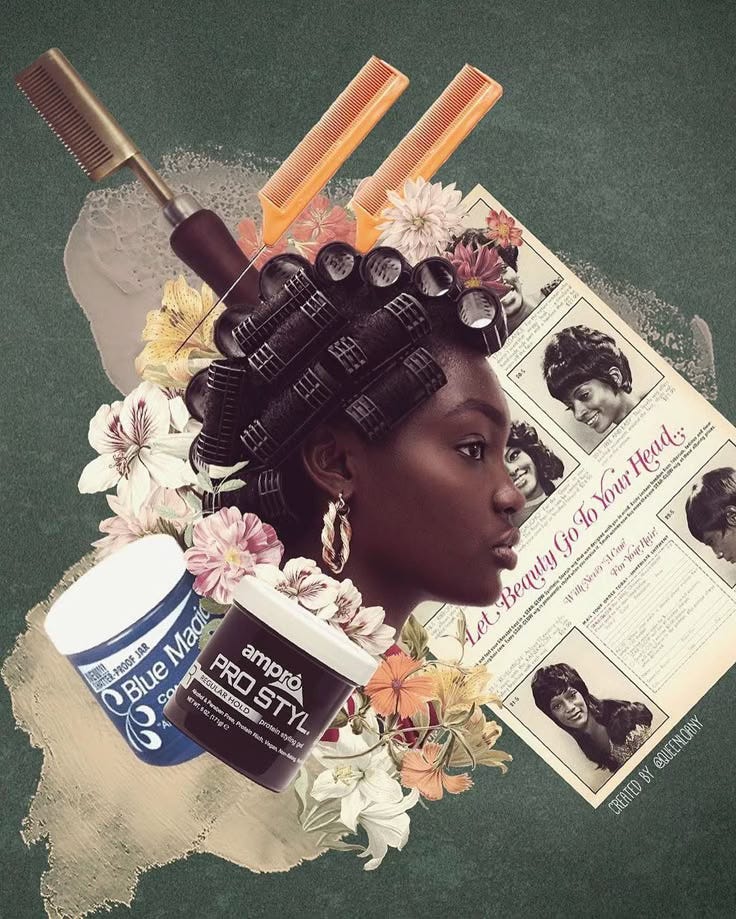
Before the flat iron, we had Marcel curling irons and the hot comb. Is there such a thing as healthy heat damage, because my hair was the healthiest with old school hairdressers, as we called them?
I say heat damage, thinking of how burnt that paper towel would look once this hair was silky smooth and laid. You know what I’m talking about, too, that sizzle from the grease when the hot comb and your hair meet.
Ooooo, girl, don’t get me started! I’m going to let this submission do the talking for me today. Let me know what you think in the comments.
Hot Comb Chronicles: Black Hair as Pedagogy
Written By misogynoir2mishpat
Hair has always been the language through which my mother figures spoke to me. Not the mothers of blood alone, but the mothers of kitchen chairs and hot combs, of Saturday mornings and patience so deep it felt like prayer. Memory takes me back to a toilet seat turned altar, where I stood small and unsteady while my mother bent me toward the sink, warm water and shampoo bathing my scalp. Her hands worked through the thickness with a tenderness that said: I know you. I will prepare you.
What followed was ritual. The dryer—that pink mechanical beast—descended over my head like a helmet, like a crown, like preparation for battle. The noise swallowed everything: television voices, story sounds, even my mother’s humming. I sat alone inside that roar, learning early what it meant to endure for the sake of transformation. You cannot read when your head must stay still. You cannot tilt toward comfort when there is work to be done.
Then came the hours between her knees, my body nested on that large green floor pillow until my bottom felt numb. Meanwhile, my mother’s fingers would part my hair into neat rows that mapped her love across my scalp. She weaved Ultra Sheen into each twist. I can close my eyes and still remember the smells of Ultra Sheen, of the hot comb, the feeling of the Black Power pick with the fists molded into it.
The hot comb was heat and history. I sat beside the kitchen stove while flames licked at metal, and I folded the top of my ear flat against my head because that was my one job. It was an early lesson to protect myself where possible—even against those in the family who would occasionally nick the tip of the ear. I’d lean forward and hold my breath, praying that my neck would not become the next victim of the hot comb as Momma would grab the kitchens.
Smoke rose toward the ceiling like heavy fog, and my mother waved the comb through air, cooling it, preparing for the next pass. Most Black girls who came of age in the 1980s carry at least one burn—a small scar, a memory of the price we paid to be presentable.
But this was more than aesthetics. This was pedagogy. While my mother’s hands moved through my hair, her mouth moved through story. My aunties gathered, their voices weaving in and out of laughter and warning. My grandmother asked questions about school, about the White children I sat beside, about teachers who did not know how to see me. She was reading me even as she massaged my scalp, trying to understand what kind of armor I would need for rooms where I was the only one, for hallways where my body was always legible as threat or curiosity, never simply as child.
Each stroke of the comb was preparation for survival. My female relatives were arming me against a hostile world. The historical record holds horrors we rarely speak aloud: White children on plantations who looked at enslaved women and saw sheep, who asked their parents if it might be fun to shear us. This is the legacy we inherit—this contempt for the very thing that grows from our bodies, this weaponization of our natural state.
And still, today, the assaults continue. In 2021, at Ganiard Elementary in Mount Pleasant, Michigan, a teacher took scissors to Jurnee Hoffmeyer’s hair without permission, without care, without consequence that matched the violation. In 2022, a Milwaukee teacher called seven-year-old Lamya Cammon to the front of the classroom and cut off her braid, admitting later that she acted out of frustration. These are not isolated incidents. They are echoes of that plantation violence, a reminder that our children are still not safe, that scissors are still wielded as weapons against Black girl bodies.
Our hair remains a spectacle and site of fascination. Strangers reach for it, wanting to touch the exotic, to confirm our difference. But they do not understand what they are touching. Each braid contains generations. Each twist holds the imprint of women who refused to let us go into the world unprotected. This was respectability politics, yes—that painful compromise Black mothers made, believing their daughters could not marry, could not secure a job or survive unless we learned to make our hair comply with European standards. But it was also love in its most practical form: the love that says, I cannot change this world, but I can prepare you for it.
I remember the night my Aunt Bonnie and cousin Vivian convinced my mother to let me sleep over—a rare permission, granted once and never again. When they returned me the next day, I wore a perfectly shaped afro. My parents had gathered people in the basement. When I walked in, everyone shouted “Surprise!” But my mother looked at my hair and she was not amused. I imagine she counted the minutes until guests left and she could undo what my aunt had done.
I had what some called “soft hair,” what others dared to name “good hair,” as if the texture that grew from my scalp could be morally superior to another’s. I resented that language even then. “You got hair?” I would say. “Good.” That was the only judgment worth making.
At ten, I enacted my own small rebellion. I had a doll named Rachel, brown-haired and long-tressed, meant to be Barbie’s companion in plastic perfection. I thought she would look better with an afro. So I took scissors and I cut, then frizzed what remained until she looked like she belonged to me, until she looked like freedom. Those were my respectability politics at ten—the understanding that beauty could be rewritten, that the standards we had been taught to chase were not inevitable.
Our hair is sacred. It carries the touch of every woman who ever loved us enough to sit us down and prepare us. When we braid, when we twist, when we lock and loose and reshape, we are continuing a tradition of survival that runs deeper than fashion, older than trends.
And so I return to that large pillow on the floor, knowing that every pass of the hot comb was a language I needed to learn. Not the language of compliance, but the language of love that prepares. The language that says: I cannot shield you from everything, but I can teach you to hold your ear. I can show you how to endure the heat. I can map protection across your scalp in neat, careful rows.
This is what our mothers gave us—not shame, but strategy. Not surrender, but survival wrapped in the smell of Ultra Sheen and the sound of sizzling hair. They taught us that we are still here, that we have not been erased, that we will not erase ourselves. They taught us in the only way they knew how: strand by strand, story by story, one Saturday morning at a time.
Just For Me: A Black Hair Story

An author I saw strolling on TikTok one night quoted, “Our hair is magic.”
If you’d like to submit your unpublished Black hair story, please email your work to me directly at jacquie@theblackstack.org. My only request is that you keep your story to a minimum of a page’s length to maximize reader engagement.
Thanks y’all!
 | A guest post by
|
Love hearing stories about the hot comb! I remember every time I would tell me my mom she burned me she would hit me with, “girl that’s just the steam from the comb.” 😒😒🙄 lol
I could see, hear, smell, and feel every word of this essay. Thank you for such a beautiful piece. 🙏🏾✨️